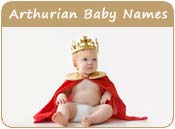
Arthurian Baby Names: Knights, Queens, and the Legends of Camelot
Few story-worlds have stocked the baby-name pool as generously as the legend of King Arthur. Stretching from sixth-century Welsh poetry through medieval French romance to Tennyson and beyond, the Matter of Britain gathers some of the oldest and most musical names in the Western tradition. Many are authentically Welsh and Celtic, reshaped by centuries of retelling, and a surprising number are thriving on modern birth certificates.
The headline story is Arthur itself, which has roared back into fashion for boys, but the legend runs far deeper than its hero. The cast swelled with every retelling: Geoffrey of Monmouth gave it a pseudo-history in the twelfth century, Chrétien de Troyes added the French romances and the grail, the Welsh Mabinogion preserved the oldest layer, Sir Thomas Malory bound it all together in Le Morte d’Arthur, and Tennyson revived it for the Victorians. Below you will find the knights, the queens and enchantresses, the wizards and kings, and even a few daring place and relic names, each sorted honestly by how wearable it really is today.
Throughout, the aim is accuracy: a real etymology for every name, the character’s true role in the story, and a frank note on which spellings travel best in the United States right now. Where a name is bound to a villain or is really a place rather than a person, you will be told plainly.
Knights and noblemen of the Round Table
This is the most usable group, full of names that read as confident and chivalrous without feeling costumed. These are the medieval hero names that anchor the whole tradition.
- Arthur (Celtic) — the once and future king, whose name is most often linked to the Celtic artos, meaning “bear,” making it a quietly powerful bear name. Geoffrey of Monmouth first cast him as a national hero, and Malory gave him his enduring tragic arc. Vintage, dignified, and very much back in style for boys — Ranks No. 105.
- Tristan (Celtic) — the tragic knight of the Tristan and Isolde romance, his name from a Pictish or Celtic original later reshaped by the French triste, “sad.” His doomed love for his uncle’s bride is one of the oldest and most retold strands of the whole cycle. Sleek and fully wearable for boys today — Ranks No. 267.
- Owen (Welsh) — the anglicized form of Owain, a great hero of the early Welsh tales, the name meaning “well-born” or “noble” and often linked to Eugene. A polished, popular noble choice — Ranks No. 26.
- Owain (Welsh) — the original Welsh spelling, hero of Owain, or the Lady of the Fountain, a tale preserved in the Mabinogion and reworked by Chrétien as Yvain. Authentic and striking, and a lovely way to honor Welsh roots directly.
- Gawain (Welsh) — Arthur’s courteous nephew, knight of the famous Green Knight tale, from the Welsh Gwalchmai, generally read as “hawk of May” or “hawk of the plain.” In the fourteenth-century poem Sir Gawain and the Green Knight he embodies the tension between courtesy and survival. Bold but handsome and genuinely usable for a brave boy.
- Gareth (Welsh) — Gawain’s younger brother, who proved himself in disguise as a kitchen boy mockingly nicknamed “Beaumains” before winning his knighthood. The form was popularized by Malory and feels gentle and contemporary.
- Geraint (Welsh) — a noble knight of the early tales whose marriage to Enid tests his trust, a beautifully Welsh name that pairs softness with strength and remains uncommon outside Wales.
- Percival (French) — the grail knight, his name an Old French coinage often read as “pierce-valley,” introduced to the legend by Chrétien de Troyes in his unfinished Perceval, the Story of the Grail. Grand and storybook; the nickname Percy makes it surprisingly easy to wear.
- Percy (French) — the friendly short form, now standing comfortably on its own as a vintage charmer for boys.
- Lancelot (French) — the greatest and most conflicted knight, beloved of Guinevere, whose affair with the queen ultimately fractures the fellowship. Heavily character-bound and theatrical, but the nickname Lance is fully wearable.
- Kay (Celtic) — Arthur’s foster brother and blunt-spoken seneschal, derived from the Welsh Cai, an old Celtic name now read as gently retro and unisex.
- Bedivere (Welsh) — the loyal knight who returns Excalibur to the lake at the king’s dying request, from the Welsh Bedwyr, one of the very oldest figures in the tradition. A rare, distinctive pull for a parent who loves the deep cuts.
- Lionel (French) — a knight of the Round Table and cousin of Lancelot, the name a diminutive of “lion.” A dapper, ready-to-wear warrior name with built-in courage.
- Bors (Celtic) — one of only three knights to achieve the Holy Grail, alongside Galahad and Percival, and the only one of the three to return to Camelot. A short, sturdy name that is genuinely obscure today and best for the very adventurous.
- Galahad (Hebrew) — the peerless grail knight and son of Lancelot, whose purity lets him alone fully behold the Holy Grail. The name comes from a biblical place name meaning “heap of testimony,” repurposed by the romancers. Saintly and grand, it is heavily character-bound, though Gala or Hal offers a softer way in.
- Tristram (Celtic) — Malory’s preferred English spelling of Tristan, a touch more antique and storybook than the streamlined modern form, and a fine way to nod to Le Morte d’Arthur directly.
- Ywain (Welsh) — the “Knight of the Lion” of Chrétien’s romance, the same hero as Owain in a French-influenced spelling, who is aided by a lion he rescues. Authentic and uncommon, with a gentle, romantic sound.
The ladies of Camelot
The women of the legend range from the queen herself to enchantresses and devoted heroines. Several are royal in feel and very current; a couple come with complicated reputations worth knowing.
- Guinevere (Welsh) — Arthur’s queen, from the Welsh Gwenhwyfar, “white phantom” or “fair one,” built from gwen (white, fair) plus a second element meaning spirit or phantom. Her love for Lancelot is the emotional engine of the later legend. Romantic, elaborate, and increasingly loved — Ranks No. 947.
- Gwen (Welsh) — the airy short form, meaning “white” or “fair” on its own. Clean, modern, and easy to wear independently — Ranks No. 698.
- Vivienne (French) — one name of the Lady of the Lake who both aids and enchants Merlin, ultimately from Latin vivus, “alive.” Elegant and thoroughly current — Ranks No. 184.
- Vivian (French) — the streamlined variant of the same Lady-of-the-Lake name, smooth and stylish for a girl or, historically, a boy.
- Nimue (Celtic) — another name for that same lake enchantress who learns Merlin’s magic and seals him away forever, a haunting and magical rarity for parents drawn to the mystical.
- Elaine (French) — a name borne by several Arthurian women and a Provencal form of Helen. Two stand out and should not be confused: Elaine of Astolat, the “Lady of Shalott” who dies of unrequited love for Lancelot, and Elaine of Corbenic, who bears Lancelot his son Galahad. Soft, vintage, and quietly making a comeback.
- Isolde (Celtic) — the Irish princess of the great Tristan romance, a Welsh and Germanic name sometimes read as “ice ruler.” Operatic and gorgeous, and more usable than its rarity suggests.
- Brangaine (Celtic) — Isolde’s loyal handmaid, whose accidental serving of the love potion sets the whole tragedy in motion. A lush, little-known name carrying real devotion, though its spelling will need defending.
- Enid (Welsh) — the patient, devoted wife of Geraint, whose constancy Tennyson celebrated in the Idylls of the King, an authentically Welsh name with a crisp, antique charm.
- Igraine (Celtic) — Arthur’s mother, whose union with Uther, arranged through Merlin’s magic, produced the king. Stately and strongly character-bound, best for a parent who wants something truly unusual.
- Lynette (Welsh) — the sharp-tongued lady who reluctantly lets Gareth escort her on a perilous quest, a delicate Welsh name with mid-century warmth.
- Laudine (French) — the “Lady of the Fountain” whom Owain marries after defeating her husband, an obscure but melodic literary pull for the dedicated.
- Ragnelle (Celtic) — the loathly lady transformed by Gawain’s courtesy when he grants her sovereignty over herself, a deep-cut name carrying one of the legend’s loveliest moral tales.
- Dindrane (Celtic) — Percival’s saintly sister, who in the grail quest gives her own life’s blood to heal a stricken lady, a rare and reverent choice for a parent moved by quiet sacrifice.
- Blanchefleur (French) — literally “white flower,” the noble lady Percival loves and defends in Chrétien’s romance. Lavishly pretty and unmistakably medieval, it is more a flourish than an everyday name, but Blanche or Fleur lifts out gracefully.
- Morgan (Welsh) — the powerful sorceress and Arthur’s half-sister, the name meaning “sea-born” or “sea-circle,” a lovely sea name. Be honest that she is often the antagonist, though Morgan reads as a friendly, modern unisex pick — Ranks No. 276.
- Morgana (Welsh) — the more dramatic feminine elaboration, beautiful but firmly tied to the enchantress and her darker reputation.
Wizards, kings, and the wider cast
Beyond the knights and ladies stand the mages, fathers, and elder kings who set the story in motion — including the most famous wizard in the world.
- Merlin (Welsh) — the prophet and magician who guides Arthur, from the Welsh Myrddin; Geoffrey of Monmouth latinized it to Merlinus, reportedly to avoid an unfortunate French resemblance. Unmistakably magical and far more wearable now than it once was, especially for a boy with a mystical streak.
- Uther (Celtic) — Arthur’s father, Uther Pendragon, an ancient Welsh name with a rugged, commanding sound for the bold.
- Ector (Celtic) — the kindly knight who raises Arthur in secret, never knowing the boy’s true parentage, a variant of Hector that feels approachable and lightly old-world.
- Pellinore (French) — the king forever pursuing the Questing Beast, an elaborate, fantastical name for a parent who wants pure Camelot grandeur.
- Balin (Celtic) — a tragic knight of the early tales whose “Dolorous Stroke” wounds a king and lays waste a kingdom, a short and unexpectedly modern-sounding option.
- Taliesin (Welsh) — the legendary sixth-century bard whose name means “radiant brow,” long woven into the Arthurian world as Britain’s chief poet and seer. Authentically Welsh and richly musical, with Tal as an easy short form.
- Mordred (Celtic) — named honestly: this is Arthur’s treacherous son and the agent of Camelot’s fall at the battle of Camlann. Striking but bound tightly to the legend’s villain, so it comes with real baggage.
Deeper cuts: more knights and ladies of the cycle
For parents who already know their Galahad from their Gawain, the romances are crowded with vivid secondary figures. Most of these are genuine rarities — wonderful for a middle name or for a family that wants a name almost no one will share.
- Tristram (Celtic) — worth repeating in its own right: Malory’s antique English spelling of Tristan, weightier and more storybook, perfect for honoring Le Morte d’Arthur while keeping the familiar Tris as a nickname.
- Lamorak (Celtic) — one of the mightiest knights of the Round Table and a brother of Percival, famed for his strength and felled in a family feud. An unusual, full-bodied name for the truly devoted.
- Gaheris (Celtic) — another of Gawain’s brothers, a knight drawn into the bloody quarrels of his family, an obscure but handsome deep cut.
- Agravain (Celtic) — the most hot-headed of Gawain’s brothers, who helps expose Lancelot and Guinevere; striking in sound but carrying some of the cycle’s discord, so weigh the association.
- Dinadan (Celtic) — the witty, clear-eyed knight whose humor and skepticism make him a favorite of modern readers, a rare name with an unusually likable character behind it.
- Lucan (Latin) — the loyal knight and royal butler who stays with Arthur to the very end, sharing the same name as the Roman poet. Quiet, dignified, and far more wearable than most names in this section.
- Caradoc (Welsh) — a stalwart knight of the early Welsh tradition, derived from a name meaning “beloved” or “amiable,” authentically Cymric and pleasingly sturdy.
- Palamedes (Greek) — the noble Saracen knight who joins the Round Table and chivalrously pursues both the Questing Beast and the love of Isolde, a name borrowed from Greek legend and prized for its courtly grandeur.
- Pendragon (Welsh) — the title-surname of Uther and Arthur, meaning “chief dragon” or “head dragon.” This is a surname and an epithet rather than a first name, magnificent but a genuine statement — one for the very bold, or for a striking middle name.
Places and relics for the very bold
A few parents will want a name straight from the geography and treasures of Camelot. These are honestly places or objects rather than characters, which makes them dramatic but unconventional as given names.
- Avalon (Celtic) — the enchanted isle where Arthur is carried to heal, a name sometimes linked to a Celtic root for “apple.” The most usable name in this group, it reads as a lyrical, mythical choice for a girl or boy.
- Camelot (Literary) — Arthur’s legendary court, a pure place name with instant romance but real boldness as a first name.
- Excalibur (Literary) — the sword drawn from the stone and returned to the lake, an object rather than a person; magnificent in spirit but a heavy lift on a birth certificate, with Cal as a wearable escape hatch.
How to choose an Arthurian name
The legend offers names at every level of daring, so the real task is matching the weight of the story to the life your child will live with it. A few honest guidelines help.
Start with the surging classics
If you want Camelot atmosphere without explanation, the safest and most charming picks are already on the charts: Arthur, Tristan, Owen, and Guinevere with its nickname Gwen, plus the elegant Vivienne. These carry the legend lightly and need no defending on the playground.
Mind the character-bound names
Some names come welded to a specific role. Mordred is the traitor, Morgana the dark enchantress, and Lancelot and Igraine sit at the heart of the story’s great betrayals and origins. They are beautiful, but a child wears the association, so choose them with open eyes or keep them for the middle slot.
Honor the Welsh roots directly
For something authentic and uncommon, reach past the anglicized forms to Owain, Geraint, Enid, Bedivere, or the bardic Taliesin. These are genuinely Welsh and reward a family that wants its heritage spoken aloud, with deep mythical resonance and very little overlap with the crowd.
Whatever you choose, an Arthurian name gives a child a story worth growing into — one of courage, loyalty, enchantment, and the bittersweet idea that the best kingdoms are always partly remembered and partly hoped for. From the booming Arthur to a whispered Nimue, the Round Table still has a seat with your family’s name on it.